
IMO / IMOI
The IMO and the IMOI models replaced the original I-P-O model of teams. These models replaced the P (process) with M (mediators). Some of the processes identified in the research for the I-P-O model have been identified as not being processes. Mathieu, Maynard, Rapp, and Gilson (2008) identified that “IPO models have been criticized for failing to distinguish multiple types of ‘processes’ and outcomes” (p. 413). Ilgen, Hollenbeck, Johnson, and Jundt (2005) documented that “many constructs presented by researchers trying to invoke the I-P-O model as process are not really process at all, but emergent cognitive or affective states” (p. 520).
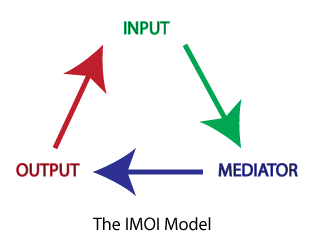
The IMO model stands for Input, Mediator, and Output, with process being replaced with mediator. The IMOI model incorporates an additional I (Input) at the end to indicate that the IMOI process is continuous with feedback mechanisms. One additional improvement to the model is that the IMOI model is not necessarily linear or additive — the IMOI process could be cyclical in nature and nonlinear.
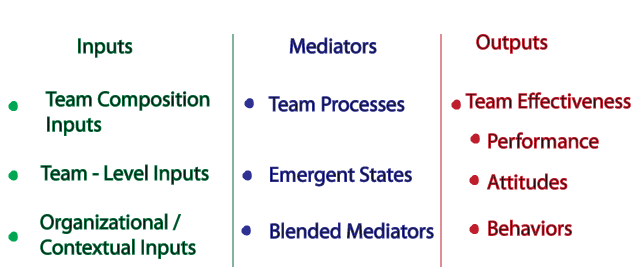
The outline provided below comes from current research. This outline for the IMOI model primarily comes from Mathieu et al. (2008). Mathieu et al. (2008) defined Inputs as “antecedent factors that enable and constrain members’ interaction” (p. 412). Team member interactions aimed at task achievement are referred to as processes, and outputs are those end products that are desirable by one or more customers (internal or external).
Overview
- Team Composition Inputs
- Mean Values
- Diversity
- Complex Combinations
- Team-Level Inputs
- Interdependencies
- Virtuality
- Training
- Team Leadership
- Team Structure
- Organizational / Contextual Inputs
- Organizational Context
- Environmental Context
- Team Processes
- Taskwork
- Teamwork
- Transition
- Action
- Interpersonal
- Team Creativity
- Brainstorming
- Emergent States
- Team Confidence
- Team Empowerment
- Team Climate
- Cohesion
- Trust
- Collective Cognition
- Blended Mediators
- Team Learning
- Behavioral Integration
- Transactive Memory
- Team Effectiveness
- Performance
- Attitudes
- Behaviors
Inputs
Mathieu et al. (2008) defined inputs as “antecedent factors that enable and constrain members’ interactions” (p. 412). In the IMOI model, inputs are categorized into three categories: team composition inputs, team-level inputs, and organizational/contextual inputs.
- Team Composition Inputs: Team composition inputs are subcategorized into three subcategories: mean values, diversity, and complex combinations. Team composition focuses on “the attributes of team members and the impact of the combination of such attributes on processes, emergent states, and ultimately outcomes” (Mathieu et al., 2008, p. 433). Cohen and Bailey (1997) provided size, tenure, demographics, and diversity as examples of group compositions.
- Mean Values: Variables that can describe average member attributes, typically by using some measure of central tendency, are identified as mean values according to Mathieu et al. (2008). The mean values consist of: locus of control, the Big Five model of personality, achievement orientation, dependability, and assertiveness.
- Locus of Control: Rotter (1966) described “the role of reinforcement, reward, or gratification is universally recognized by students of human nature as a crucial one in the acquisition and performance of skills and knowledge” (p. 1). The role of reinforcement, reward, or gratification could be perceived differently from one person to the next. Rotter (1966) differentiated these two beliefs as internal locus of control and external locus of control. “Internals believe that they have control over their environment, whereas externals view their lives as controlled by external factors” (Chen & Wang, 2007, p. 506). Rotter (1966) used the internal-external locus of control scale to measure general control orientation, with a single score on a scale ranging from highly internal to highly external.
- Diversity: Content for this section is under development and will be added soon.
- Complex Combinations: Content for this section is under development and will be added soon.
- Mean Values: Variables that can describe average member attributes, typically by using some measure of central tendency, are identified as mean values according to Mathieu et al. (2008). The mean values consist of: locus of control, the Big Five model of personality, achievement orientation, dependability, and assertiveness.
- Team-Level Inputs:
- Interdependencies: Content for this section is under development and will be added soon.
- Virtuality: Content for this section is under development and will be added soon.
- Training: Content for this section is under development and will be added soon.
- Team Leadership: Content for this section is under development and will be added soon.
- Team Structure: Content for this section is under development and will be added soon.
- Organizational / Contextual Inputs:
- Organizational Context: Content for this section is under development and will be added soon.
- Environmental Context: Content for this section is under development and will be added soon.
Mediators
- Team Processes:
- Taskwork: Content for this section is under development and will be added soon.
- Teamwork: Content for this section is under development and will be added soon.
- Transition: Content for this section is under development and will be added soon.
- Action: Content for this section is under development and will be added soon.
- Interpersonal: Content for this section is under development and will be added soon.
- Team Creativity: Content for this section is under development and will be added soon.
- Brainstorming: Content for this section is under development and will be added soon.
- Emergent States:
- Team Confidence: Content for this section is under development and will be added soon.
- Team Empowerment: Content for this section is under development and will be added soon.
- Team Climate: Content for this section is under development and will be added soon.
- Cohesion: Content for this section is under development and will be added soon.
- Trust: Content for this section is under development and will be added soon.
- Collective Cognition: Content for this section is under development and will be added soon.
- Blended Mediators:
- Team Learning: Content for this section is under development and will be added soon.
- Behavioral Integration: Content for this section is under development and will be added soon.
- Transactive Memory: Content for this section is under development and will be added soon.
Outputs
- Team Effectiveness:
- Performance: Content for this section is under development and will be added soon.
- Attitudes: Content for this section is under development and will be added soon.
- Behaviors: Content for this section is under development and will be added soon.
See Also
References
Chen, J. & Wang, L. (2007). Locus of control and the three components of commitment to change. Personality and Individual Differences, 42(3), 503–512.
Cohen, S. G. & Bailey, D. E. (1997). What makes teams work: Group effectiveness research from the shop floor to the executive suite. Journal of Management, 23, 239–290.
Ilgen, D. R., Hollenbeck, J. R., Johnson, M., & Jundt, D. (2005). Teams in organizations: From input-process-output models to IMOI models. Annual Review of Psychology, 56, 517–543. doi: 10.1146/annurev.psych.56.091103.070250
Mathieu, J., Maynard, M. T., Rapp, T., & Gilson, L. (2008). Team effectiveness 1997–2007: A review of recent advancements and a glimpse into the future. Journal of Management, 34, 410–476. doi: 10.1177/0149206308316061
Rotter, J. B. (1966). Generalized expectancies for internal versus external control of reinforcement. Psychological Monographs, 80(1, Whole No. 609).