
I-P-O: Input, Process, Output
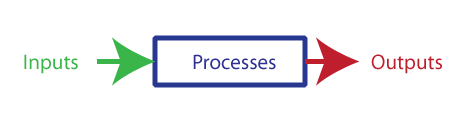
Early research on teams focused on the Input, Process, and Output (I-P-O) model that was originally presented by McGrath in 1984. The I-P-O model looked at inputs that are configured in processes to produce the desired output.
In the I-P-O model, processes describe how inputs are transcribed into outputs. Mathieu et al. (2008) identified processes as those that “describe members’ interactions directed toward task accomplishment” (p. 412). Cohen and Bailey (1997) identified processes as the interactions among group members and external agents.
Team processes include, but are not limited to: the means by which team members communicate to one another, the tasks that team members work on together, the tasks that team members work on independently, the common goals and deadlines for the team members, the usage of inputs to perform tasks, the effective use of team members to produce outputs, and the feedback and restructuring to prepare for the next task / goal. Marks, Mathieu, and Zaccaro (2001) defined team processes as “members’ interdependent acts that convert inputs to outcomes through cognitive, verbal, and behavioral activities directed toward organizing taskwork to achieve collective goals” (p. 357). The basic concept is that processes convert inputs into outputs.
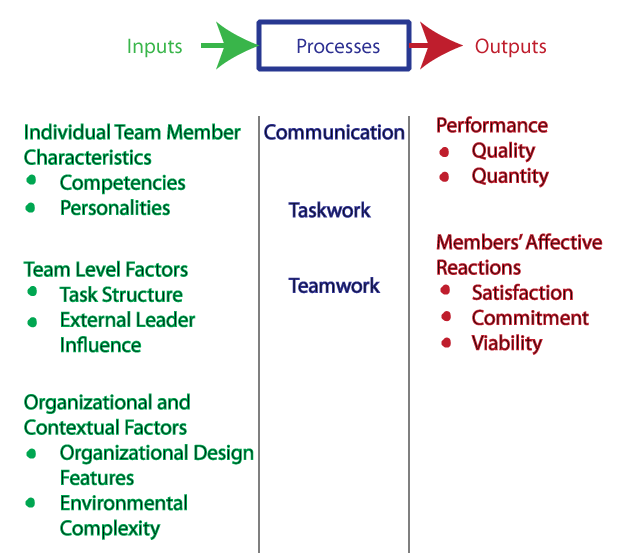
Most of the information in the above table can be found in Mathieu, Maynard, Rapp, and Gilson (2008).
The I-P-O model has served as the main research model of teams in organizations for more than 40 years (Mathieu et al., 2008). Newer research has added to the I-P-O model in recent years to include various modifications of the original model including temporal features (McGrath, 1991; Marks, Mathieu, & Zaccaro, 2001), team cognition (DeChurch & Mesmer-Magnus, 2010; Cannon-Bowers & Salas, 2001; Wiedow & Konradt, 2011) and team learning concepts (Wilson, Goodman & Cronin, 2007; Ellis et al., 2003; London & Sessa, 2007), mediators that transform/assist inputs into outputs (Ilgen et al., 2005), and affective domains such as group psychosocial traits (Cohen & Bailey, 1997), team member sense of belonging, psychological safety (Kostopoulos & Bozionelos, 2011), and team cohesion (Piper et al., 1983).
The original I-P-O model gave the field of team/group research a great foundation to build upon. However, the I-P-O model has been considered, by some, to be insufficient to meet today’s complex environment. Ilgen, Hollenbeck, Johnson, and Jundt (2005) identified that the I-P-O framework was insufficient for characterizing teams for the following reasons: Many of the identified processes were not processes at all, they were emergent cognitive or affective states; the I-P-O framework implies a single-cycle linear path where inputs are transferred into outputs, with no feedback or feedforward loops; and the I-P-O model suggests a linear path from Input to Process to Output, whereas most team functions operate in a cyclical and continuous fashion.
Alternative models to the I-P-O model are the IMO and the IMOI models. The IMO model identifies the inputs, mediators, and outputs. The IMOI model identifies the inputs, mediators, and outputs, and adds an additional feedback loop indicated by the input at the end, thus IMOI. Three distinctive differences between the IMOI model and the I-P-O model are: the IMOI model is not linear (as indicated by the dashes in the I-P-O model), the IMOI has a feedback loop indicated by the “I” at the end of the acronym, and the IMOI model replaces the P (process) in the I-P-O model with an M (mediator). Ilgen et al. (2005) indicated that this substitution “reflects the broader range of variables that are important mediational influences with explanatory power for explaining variability in team performance and viability” (p. 520).
Overview
- Individual Team Member Characteristics
- Competencies
- Personalities
- Team Level Factors
- Task Structure
- External Leader Influence
- Organizational & Contextual Factors
- Organizational Design Features
- Environmental Complexity
- Performance
- Quality
- Quantity
- Members’ Affective Reactions
- Satisfaction
- Commitment
- Viability
Input
Earlier research had focused on the team performance and the viability of teams with emphasis on inputs such as composition, structures, or reward allocations (Ilgen et al., 2005). Mathieu et al. (2008) referenced earlier work by McGrath where inputs were defined as “antecedent factors that enable and constrain members’ interactions” (p. 412). The inputs from McGrath’s earlier IPO model included individual team member characteristics, team-level factors, and organizational and contextual factors. Individual team member characteristics include competencies and personalities of team members. Team-level factors include task structure and external leader influences, while organizational and contextual factors include organizational design features and environmental complexity (Mathieu et al., 2008).
- Individual Team Member Characteristics:
- Competencies: Competencies refer to the knowledge, skills, and abilities of team members (KSAs).
- Personalities: Team member personalities are composed of locus of control, introversion-extraversion, and other personality matrices. Recent research has focused more attention to the Big Five model of personality, which measures Neuroticism, Extraversion, Openness to Experience, Agreeableness, and Conscientiousness.
- Team Level Factors:
- Task Structure: Gladstein (1984) categorized group tasks into three components: size (group size), leadership (leadership activities), and structuring of activities (goal and role clarity, norms about work procedures, task control) (Table 2, p. 508).
- External Leader Influence: Leadership, should it come from within the team or external to the team? What type of leadership is most effective for different types of teams? Leadership is considered an input under the current IPO model. Gladstein (1984) identified leadership as having three components: task leadership, maintenance leadership, and leadership influence (Figure 2, p. 509). Zaccaro, Rittman, and Marks (2001) indicated that organizational performance relies, in part, on team effectiveness and on the teams’ leadership structure. Mathieu, Maynard, Rapp, and Gilson (2008) identified that external team leadership and shared leadership models “hold particular promise for future research efforts” (p. 449).
- Cohen and Bailey (1997) found in their research of management teams that “leaders who actively listened to team members and incorporated their ideas into a final recommendation significantly affected members’ attachment to the team, their trust in the leader, and the quality of decisions made” (p. 274).
- Organizational and Contextual Factors:
- Organizational Design Features:
- Mathieu et al. (2008) addressed a multilevel approach of viewing teams by identifying that “individuals are nested in teams, which in turn are nested in organizations, which exist in environments” (p. 412).
- McGrath, Arrow, and Berdahl (2000) viewed groups as “open and complex systems that interact with the smaller systems (i.e., the members) embedded within them and the larger systems (e.g., organizations, communities) within which they are embedded” (p. 98).
- At the organizational level, Gladstein (1984) identified two organizational categories as inputs: resources available and organizational structure. Resources available were composed of training and technical consultation, and markets served. Organizational structure was composed of rewards for group performance, and supervisory control (Figure 1, p. 502).
- Environmental Complexity:
- As identified above, under organizational design features, Mathieu et al. (2008) identified the multilevel approach to viewing teams: individual, organizational, and environment.
- Cohen and Bailey (1997) viewed environmental factors as “drivers of team and compositional inputs” (as cited in Mathieu et al., 2008, p. 412).
- Organizational Design Features:
Process
Mathieu et al. (2008) identified that team processes “describe members’ interactions directed toward task accomplishment” (p. 412). Processes describe how inputs are converted into outputs. The processes identified in previous IPO research have been scrutinized recently for “failing to distinguish multiple types of ‘processes’ and outcomes” (Mathieu et al., 2008, p. 413). Ilgen et al. (2005) identified that under the IPO model, “the mediational factors that intervene and transmit the influence of inputs to outcomes are not processes” (p. 520). The processes listed below are those that have been identified under the literature using the IPO model. More recent processes and mediators are listed under the IMO / IMOI model.
- Communication:
- Cohen and Bailey (1997) reviewed research relating to project teams. Their findings indicated that “teams high in cooperation relied more heavily on informal modes of communication than did low cooperation teams” (p. 264).
- Gladstein (1984) categorized group processes into two process behaviors: maintenance behaviors and task behaviors. Maintenance behaviors were divided into three subcategories: “open communication of ideas and feelings, supportiveness, and low interpersonal conflict” (Gladstein, 1984, p. 505). Task behaviors were assessed using five subcategories, such as weighting individual inputs by knowledge and skill, and boundary management (handling of relationships external to the group that are critical to task accomplishment) (Gladstein, 1984).
- Taskwork:
- Listed under internal processes, Cohen and Bailey (1997) identified conflict and collaboration. Within conflict, two types of conflict were listed: “relationship conflict (interpersonal incompatibilities, tension, animosity, and annoyance) and task conflict (disagreement among group members about task content)” (p. 255). Task conflict was found to be detrimental for groups performing routine tasks, as opposed to being non-detrimental for groups performing non-routine tasks (Cohen & Bailey, 1997).
- Ancona and Caldwell (1992a, b) defined task process as “the group’s ability to develop plans, define goals, and prioritize work” (as cited in Cohen & Bailey, 1997, p. 264).
- Tasks were originally classified by McGrath (1984) as generate, choose, negotiate, and execute (as cited in Straus, 1999). Tasks categorized as generate are collaborative or cooperative, compared to tasks categorized as choose which require coordination. Tasks categorized as negotiate are often subjective and cause conflict among team members. Tasks categorized as execute require coordinative efforts among team members (further description can be found in Straus, 1999).
- Teamwork
Output
- Performance:
- Mathieu et al. (2008) identified team effectiveness outcomes when measuring performance, composed of quality and quantity of the team’s work.
- Members’ Affective Reactions:
- Cohen and Bailey (1997) looked at team effectiveness through attitudinal measures (employee satisfaction, commitment, and trust in management) and behavioral measures (absenteeism, turnover, and safety). Mathieu et al. (2008) identified team effectiveness outcomes as team members’ affective reactions (satisfaction, commitment, viability).
See Also
References
Cannon-Bowers, J. A. & Salas, E. (2001). Reflections on shared cognition. Journal of Organizational Behavior, 22(2), 195–202. doi: 10.1022/job.82
Cohen, S. G. & Bailey, D. E. (1997). What makes teams work: Group effectiveness research from the shop floor to the executive suite. Journal of Management, 23, 239–290.
DeChurch, L. A. & Mesmer-Magnus, J. R. (2010). The cognitive underpinnings of effective teamwork: A meta-analysis. Journal of Applied Psychology, 95, 32–53. doi: 10.1037/a0017328
Ellis, A. P. J., Hollenbeck, J. R., Ilgen, D. R., Porter, C. O. L. H., West, B. J., & Moon, H. (2003). Team learning: Collectively connecting the dots. Journal of Applied Psychology, 88(5), 821–835. doi: 10.1037/0021-9010.88.5.821
Gladstein, D. L. (1984). Groups in context: A model of task group effectiveness. Administrative Science Quarterly, 29, 499–517.
Ilgen, D. R., Hollenbeck, J. R., Johnson, M., & Jundt, D. (2005). Teams in organizations: From input-process-output models to IMOI models. Annual Review of Psychology, 56, 517–543. doi: 10.1146/annurev.psych.56.091103.070250
Kostopoulos, K. C. & Bozionelos, N. (2011). Team exploratory and exploitative learning: Psychological safety, task conflict, and team performance. Group & Organization Management, 36(3), 385–415. doi: 10.1177/1059601111405985
London, M. & Sessa, V. I. (2007). How groups learn, continuously. Human Resource Management, 46(4), 651–669. doi: 10.1002/hrm.20186
Marks, M. A., Mathieu, J. E., & Zaccaro, S. J. (2001). A temporally based framework and taxonomy of team processes. Academy of Management Review, 26(3), 356–376. Retrieved from http://journals.aomonline.org/amr/
Mathieu, J., Maynard, M. T., Rapp, T., & Gilson, L. (2008). Team effectiveness 1997–2007: A review of recent advancements and a glimpse into the future. Journal of Management, 34, 410–476. doi: 10.1177/0149206308316061
McGrath, J. E. (1991). Time, interaction, and performance (TIP): A theory of groups. Small Group Research, 22(2), 147–174. Retrieved from http://sgr.sagepub.com/content/22/2/147
McGrath, J. E., Arrow, H., & Berdahl, J. L. (2000). The study of groups: Past, present, and future. Personality and Social Psychology Review, 4, 95–105. doi: 10.1207/S15327957PSPR0401_8
Piper, W. E., Marrache, M., Lacroix, R., Richardsen, A. M., & Jones, B. D. (1983). Cohesion as a basic bond in groups. Human Relations, 36(2), 93–108. doi: 10.1177/001872678303600201
Straus, S. G. (1999). Testing a typology of tasks: An empirical validation of McGrath’s (1984) group task circumplex. Small Group Research, 30(2), 166–187. doi: 10.1177/104649649903000202
Wiedow, A. & Konradt, U. (2011). Two-dimensional structure of team process improvement: Team reflection and team adaptation. Small Group Research, 42, 32–54. doi: 10.1177/1046496410377358
Wilson, J. M., Goodman, P. S., & Cronin, M. A. (2007). Group learning. Academy of Management Review, 32(4), 1042–1059. doi: 10.5465/AMR.2007.26585724
Zaccaro, S. J., Rittman, A. L., & Marks, M. A. (2001). Team leadership. Leadership Quarterly, 12(4), 451–483. Retrieved from EBSCOhost.