
Temporally-Based Taxonomy
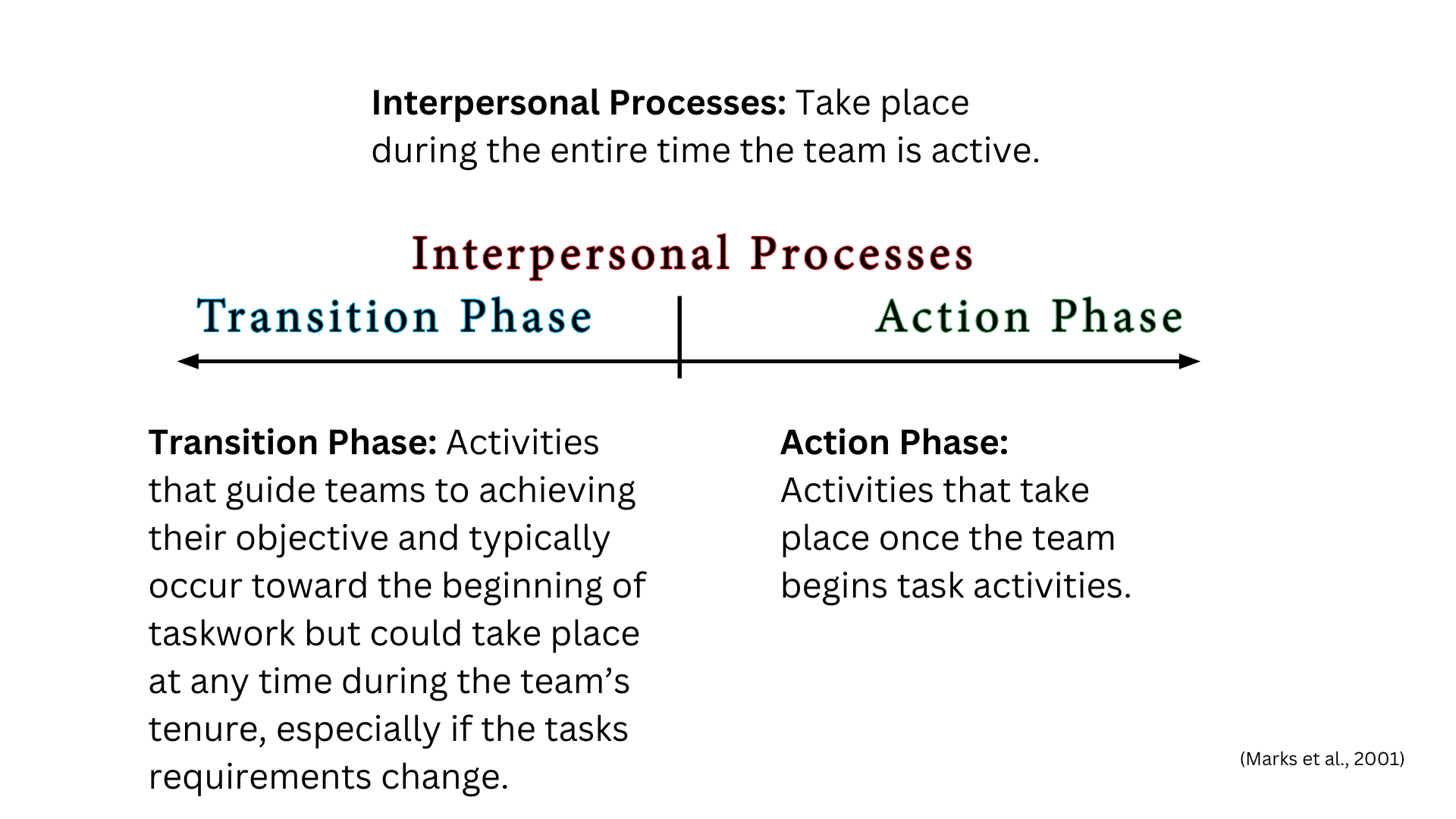
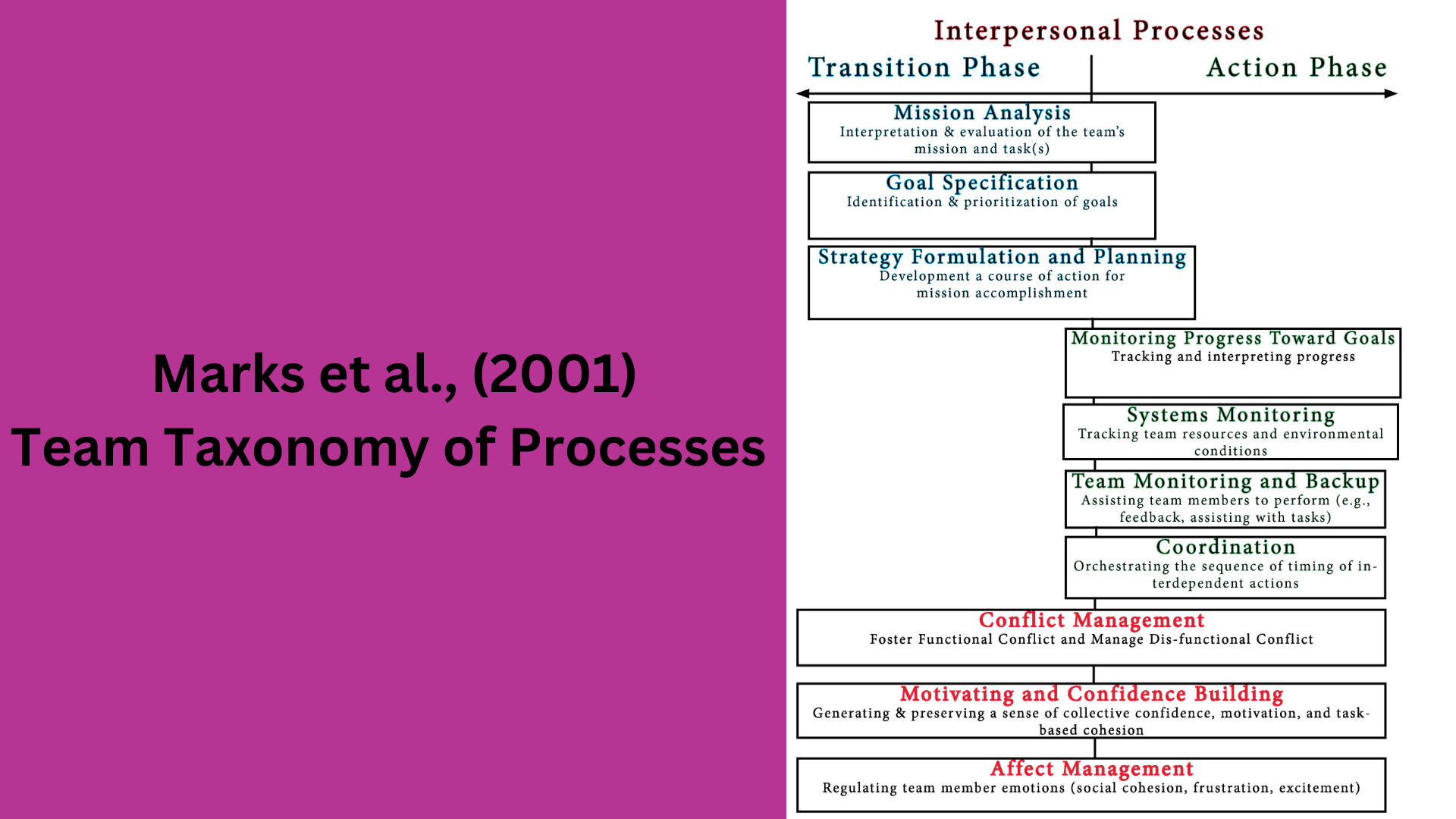
The Temporally-Based Taxonomy, developed by Marks, Mathieu, and Zaccaro (2001), organizes team processes into three dimensions that operate across performance episodes: transition phase processes, action phase processes, and interpersonal processes. Team processes are multidimensional, involving both teamwork and taskwork that operate at different stages of the team’s tenure while remaining sequentially connected. Transition and action phases alternate throughout a team’s performance episode, while interpersonal processes are active throughout the entire time the team is engaged.
Overview
The taxonomy distinguishes between activities that guide teams before and after task execution (transition phases) and activities that occur during active performance (action phases), with interpersonal processes operating across both. This framework extends the Input–Process–Output (IPO) model by recognizing that team processes are not a single undifferentiated mechanism but a structured set of activities that unfold across time and performance episodes.
Transition Phase Processes
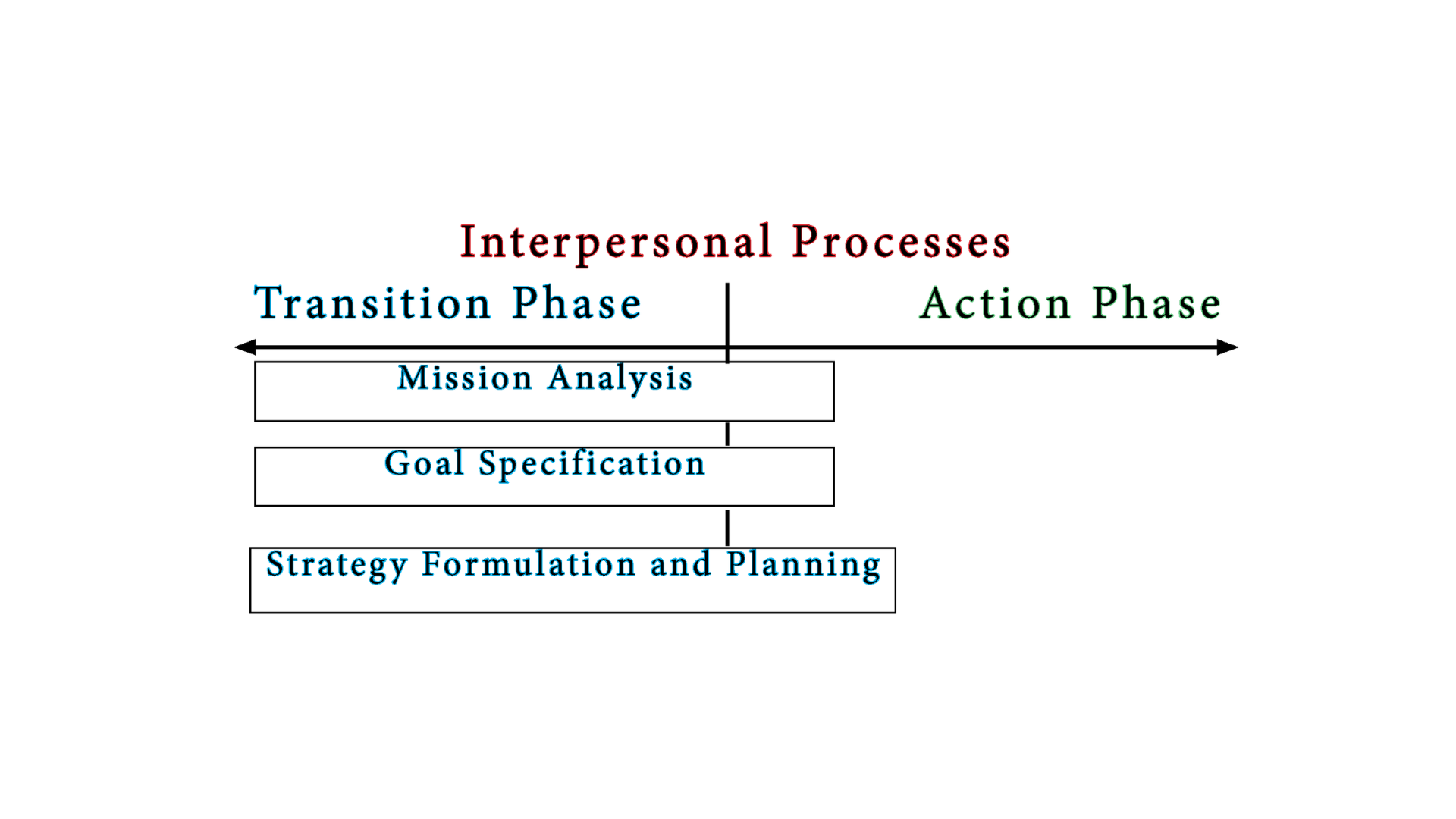
Transition phase processes guide teams toward achieving their objectives and typically occur at the beginning of taskwork, though they can take place at any point during the team’s tenure—particularly when task requirements change. There are three core transition processes: mission analysis involves the interpretation and evaluation of the team’s mission and tasks; goal specification involves the identification and prioritization of goals derived from that mission; and strategy formulation and planning involves developing a course of action for mission accomplishment. Together, these activities establish the direction and structure that guide the team’s subsequent action phase efforts (Marks et al., 2001; Turner et al., 2020).
Action Phase Processes
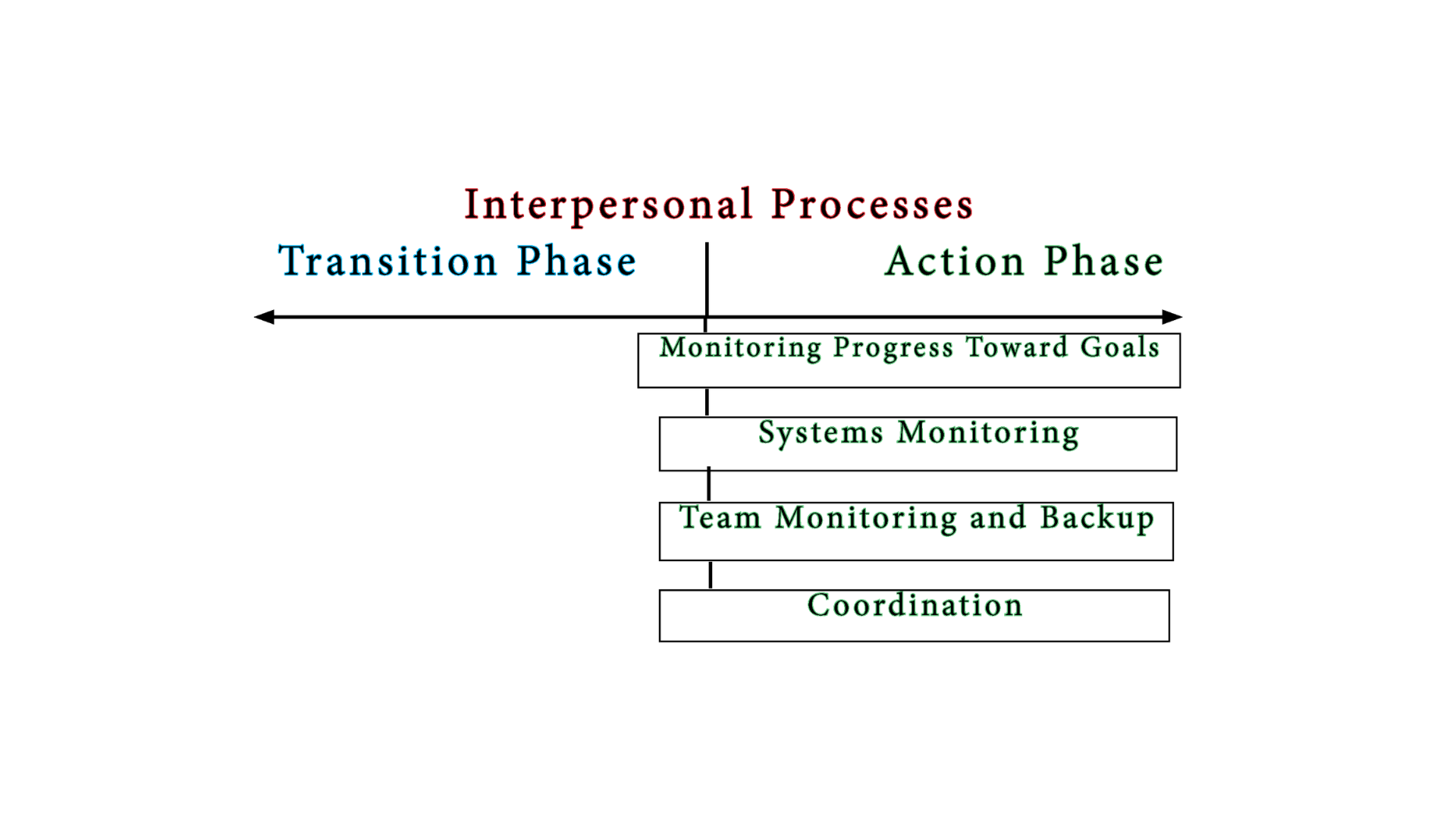
Action phase processes take place once the team begins executing its tasks. Four sub-dimensions are identified: monitoring progress toward goals involves tracking and interpreting the team’s progress relative to its goals; systems monitoring involves tracking team resources and environmental conditions that affect performance; team monitoring and backup behavior involves assisting team members to perform their tasks effectively, including feedback and workload sharing; and coordination involves orchestrating the sequence and timing of interdependent actions across team members. These processes require ongoing attention throughout the action phase and are primarily the responsibility of the component team, though boundary spanners remain engaged with systems monitoring (Turner et al., 2020).
Interpersonal Processes
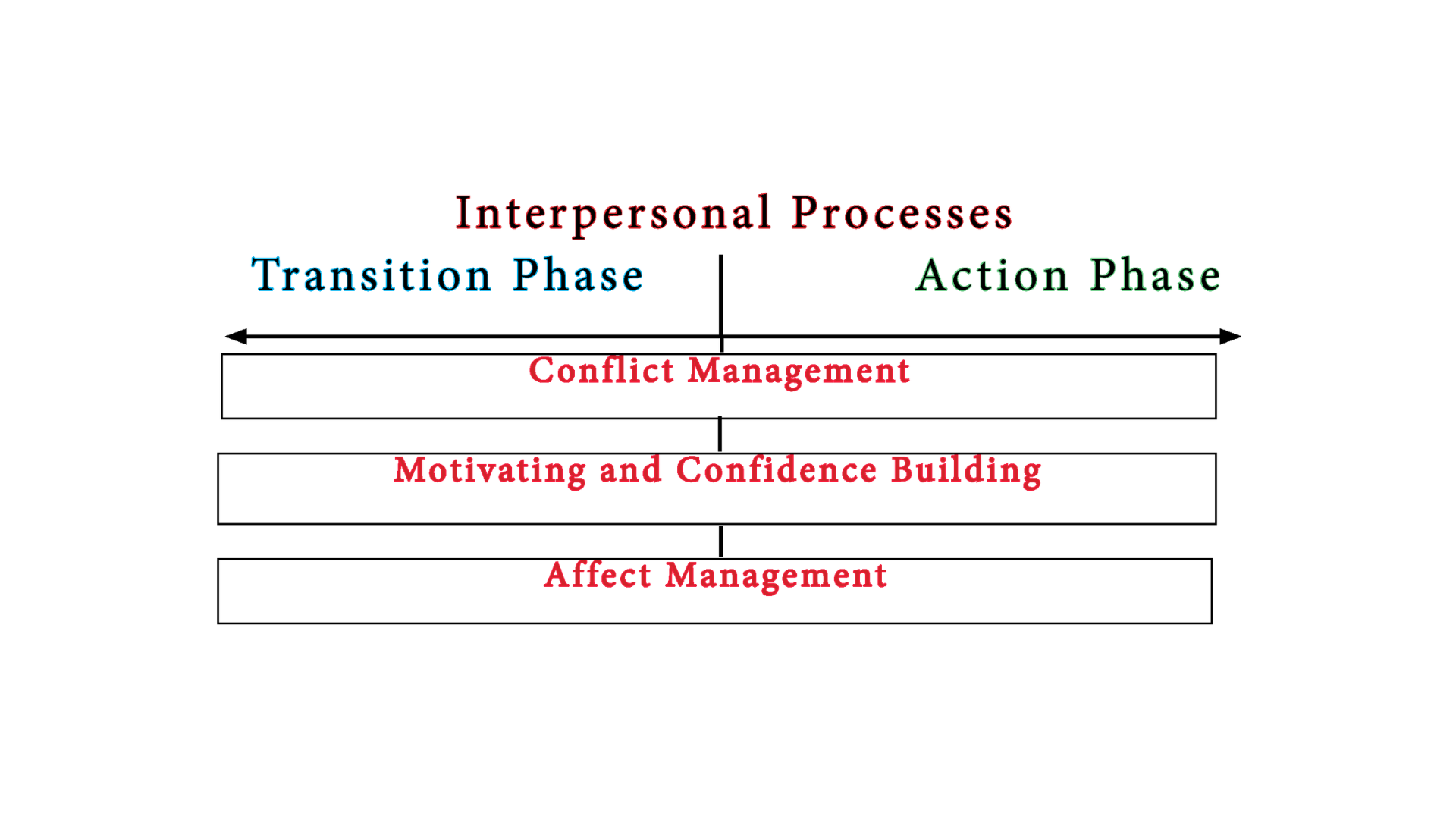
Interpersonal processes operate throughout the entire time the team is active—during both transition and action phases. Three sub-dimensions are identified: conflict management involves both fostering functional conflict and managing dysfunctional conflict within and between teams; motivating and confidence building involves generating and preserving a sense of collective confidence, motivation, and task-based cohesion; and affect management involves regulating team members’ emotions, including social cohesion, frustration, and excitement. Unlike the other two process types, interpersonal processes are not bound to a single performance phase and involve all levels of the team structure—from the individual team member to the multiteam system boundary spanner (Marks et al., 2001; Turner et al., 2020).
Composite Model
The composite model integrates all three process dimensions into a unified view of team activity across a performance episode. Mission analysis, goal specification, and strategy formulation anchor the transition phase. Monitoring progress toward goals, systems monitoring, team monitoring and backup, and coordination activities define the action phase. Conflict management, motivation and confidence building, and affect management operate throughout both phases. This layered view captures the full range of teamwork and taskwork processes that contribute to team effectiveness and forms the basis for multilevel team effectiveness models that extend the taxonomy to multiteam systems (Turner, Baker, Ali & Thurlow, 2020).
See Also
References
Marks, M. A., Mathieu, J. E., & Zaccaro, S. J. (2001). A temporally based framework and taxonomy of team processes. Academy of Management Review, 26(3), 356–376. https://doi.org/10.5465/amr.2001.4845785
Turner, J. R., Baker, R., Ali, Z., & Thurlow, N. (2020). A new multiteam system (MTS) effectiveness model. Systems, 8(2), 12. https://doi.org/10.3390/systems8020012