
The Three Facets of Team Conflict
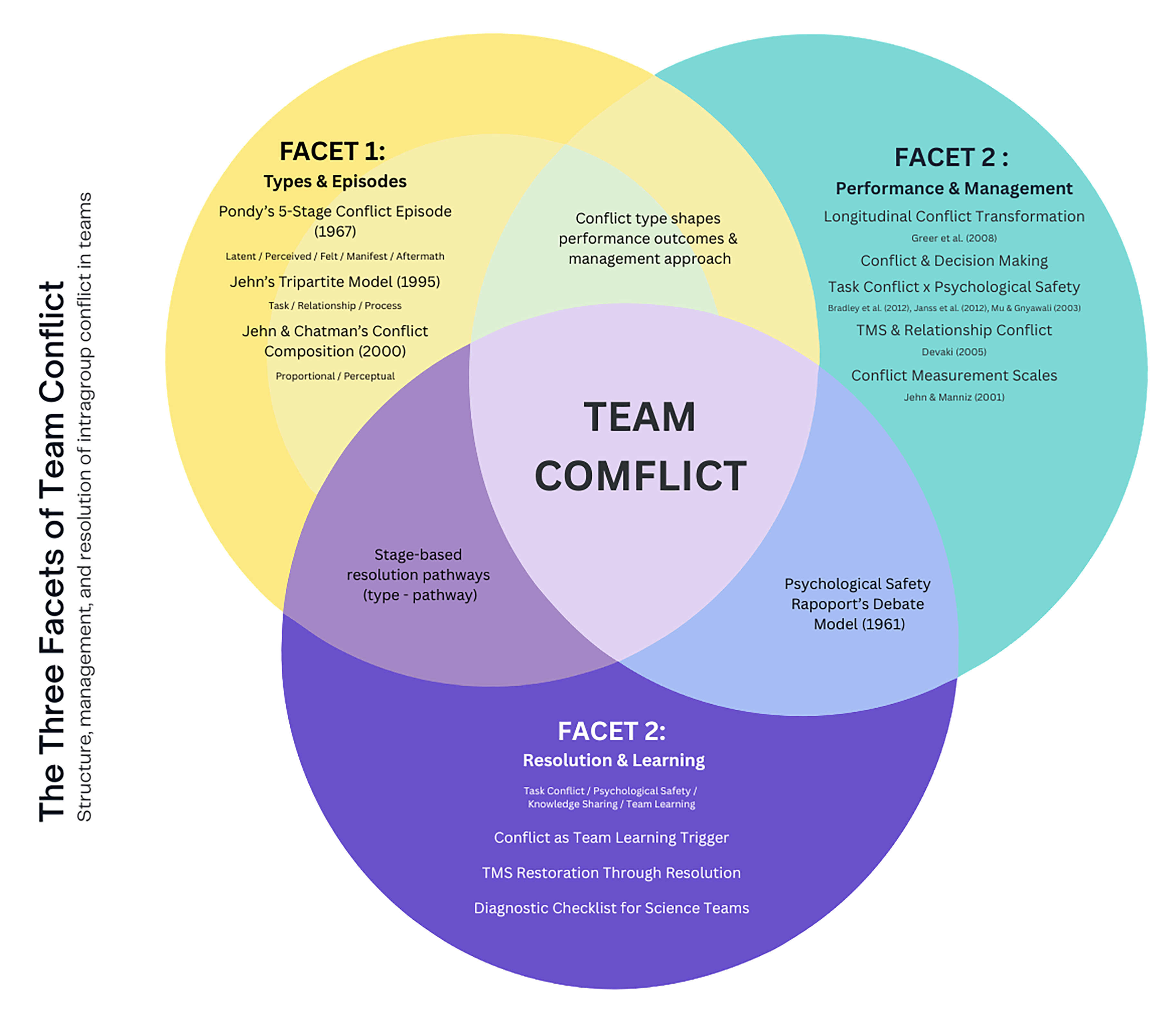
Understanding team conflict fully requires examining it across three interconnected facets: its structural types and how they unfold over time, how conflict affects performance and what can be done about it, and how teams move through conflict toward resolution and learning. The pages below outline the scope of each facet.
1. Team Conflict — Types and Episodes
The definitional and structural core of team conflict: Pondy’s (1967) five-stage conflict episode model, Jehn’s (1995) tripartite in detail, cross-source definitions across task, relationship, and process conflict, and Jehn and Chatman’s (2000) proportional and perceptual conflict composition.
2. Team Conflict — Performance and Management
Performance and practice implications of team conflict: longitudinal effects (Greer et al., 2008), conflict and decision making, the task conflict–psychological safety interaction (Bradley et al., 2012; Janss et al., 2012; Mu & Gnyawali, 2003), TMS and relationship conflict (Devaki, 2005), Rapoport’s (1961) debate model, and the Jehn & Mannix (2001) measurement scales.
3. Team Conflict — Resolution and Learning
How teams move from conflict through resolution and into learning: Rapoport’s debate model as a behavioral standard, psychological safety as the bridge between conflict and learning, the task conflict → safety → knowledge sharing → team learning pathway, conflict as a trigger for team learning dimensions, TMS restoration through resolution, and a diagnostic checklist for science teams.
References
Bradley, B. H., Postlethwaite, B. E., Klotz, A. C., & Brown, K. G. (2012). Reaping the benefits of task conflict in teams: The critical role of team psychological safety climate. Journal of Applied Psychology, 97(1), 151–158. https://doi.org/10.1037/a0024200
Devaki, N. (2005). Relationship conflict, social capital, and trust: The effects of transactive memory on team performance. Academy of Management Journal, 48(4), 633–651.
Greer, L. L., Jehn, K. A., & Mannix, E. A. (2008). Conflict transformation: A longitudinal investigation of the relationships between different types of intragroup conflict and the moderating role of conflict resolution. Small Group Research, 39, 278–302. https://doi.org/10.1177/1046496408317793
Janss, R., Rispens, S., Segers, M., & Jehn, K. A. (2012). What is happening under the surface? Power, conflict and the performance of medical teams. Medical Education, 46(9), 838–849. https://doi.org/10.1111/j.1365-2923.2012.04322.x
Jehn, K. A. (1995). A multimethod examination of the benefits and detriments of intragroup conflict. Administrative Science Quarterly, 40, 256–282. http://www.jstor.org/stable/2393638
Jehn, K. A., & Chatman, J. A. (2000). The influence of proportional and perceptual conflict composition on team performance. The International Journal of Conflict Management, 11, 56–73. https://doi.org/10.1108/eb022835
Jehn, K. A., & Mannix, E. A. (2001). The dynamic nature of conflict: A longitudinal study of intragroup conflict and group performance. Academy of Management Journal, 44, 238–251. https://doi.org/10.2307/3069453
Mu, S., & Gnyawali, D. R. (2003). Developing synergistic knowledge in student groups. Journal of Higher Education, 74(6), 689–711. https://doi.org/10.1353/jhe.2003.0051
Pondy, L. R. (1967). Organizational conflict: Concepts and models. Administrative Science Quarterly, 12, 296–320. http://www2.johnson.cornell.edu/publications/asq
Rapoport, A. (1961). Fights, games, and debates. University of Michigan Press.